





article AI Superpower for Small Businesses
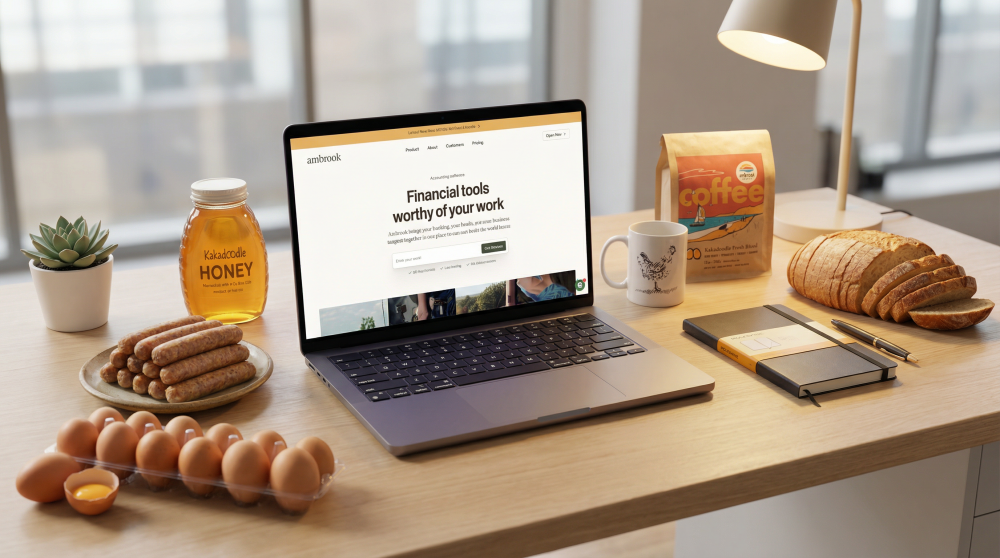
A few days ago, I sent a note to the Ambrook team, the accounting software we use at Kakadoodle.
It was a pretty technical suggestion. I’d been working on connecting the different systems we use across the business and thinking about how AI could interact with that data more naturally. There’s a growing concept where AI can securely access and work across a company’s information, and it felt obvious that accounting would eventually need to be part of that.
I basically said, you guys have to be thinking about this.
A couple days later, I was on a call with them.
Not just support. A real conversation. One of their cofounders joined, along with the head of a new AI initiative they had just formed. This was clearly something already top of mind for them.
And it made sense. Ambrook, like so many companies right now, is trying to figure out what its relationship with AI should be.
They’ve already done a thoughtful job integrating AI into their application and interface. You can see where things are heading. But part of our conversation drifted into a bigger realization.
The interface itself may matter less than we think.
Where the conversation really opened up
Behind the scenes, I’ve been wiring together the systems that run Kakadoodle.
Sales data. Customer data. inventory. farm production. analytics. finances.
The goal has been simple. Understand the business more clearly. Not in theory. In practice.
And in many ways, this is already happening.
Most of our operational data can already talk to each other through shared systems and AI tooling. I can ask questions across multiple parts of the business and get real answers.
Except for one place.
Accounting.
That’s still largely separate. Still more manual. Still harder to connect into the bigger picture.
That’s what prompted me to reach out to Ambrook in the first place.
Because once that piece connects, the entire business becomes easier to understand as a whole.
Beyond the app
During our conversation, we talked about how companies like Ambrook are starting to integrate AI directly into their applications and interfaces.
That’s a meaningful step forward.
But we also found ourselves talking about something bigger.
If AI only lives inside an app, it helps. But it’s limited.
The real shift happens when the data itself can move across systems. When different tools can speak to each other. When AI can help you understand the business as a whole, not just one slice of it at a time.
Not navigating dashboards.
Just asking: How much money did we make? Why did revenue change? What was our best selling product? Where are we losing margin?
And getting an answer grounded in the full picture.
That’s a different way of operating.
The moment that clicked
At one point they asked how AI is actually helping Kakadoodle today, not in theory.
My answer went straight to something I’ve thought about for years.
There’s a long list of companies that tried to build local food platforms and struggled.
One that always stuck with me was Farmigo. They raised around $30 million to build software and infrastructure to connect local farms and consumers.
A huge portion of that went into building the technology itself. Teams. engineering. systems.
And even with all of that, it still didn’t ultimately work.
Not because the mission was wrong. The mission was right.
But because the cost and complexity of building the infrastructure was enormous.
That’s what feels different now.
Today, a small team can build systems that used to require massive funding and large engineering organizations. The speed is different. The cost is different. The learning cycles are different.
AI is a big part of that shift.
Not as hype. As leverage.
It allows small businesses to see, learn, and adapt faster. And in an industry like local food, that speed may be one of the missing ingredients previous attempts didn’t have.
Where this shows up in real life
A good example is margins.
There was a stretch where our margins on certain products drifted without us fully realizing it. Not dramatically. Just slowly.
You stay busy. You focus on operations. And meanwhile something important can quietly move in the wrong direction.
By the time you feel it, you’re already reacting.
What better tools allow is earlier visibility.
Not perfect answers. Just earlier signals.
That alone changes how a small business survives.
The part of the conversation that turned personal
Later in the conversation, they asked something that caught me off guard.
It wasn’t about AI. It wasn’t about accounting.
It was basically: How do you keep going through all of this?
From their perspective, we were talking about survival and independence. I don’t think they knew the full story at that point.
So I told them.
About cancer.
About losing our flock to bird flu.
About funding freezes.
About moments where it felt like everything might collapse.
There was a pause after that.
And the conversation shifted. It wasn’t theoretical anymore.
We started talking about resilience. About control. About how much of building something like this is planning versus simply staying steady through unpredictable seasons.
I shared that I’ve come to think about it this way:
Do the right things you can control.
Accept that some things you can’t.
A lot of that mindset was shaped during those harder seasons. And honestly, it shapes Kakadoodle more than any piece of technology ever will.
Why this conversation mattered
What stayed with me wasn’t a feature or a product idea.
It was the realization that multiple shifts are happening at once.
Small teams can now:
see their business more clearly
learn faster
build faster
operate without massive overhead
Combine that with:
growing demand for clean food
better logistics
more direct relationships between farmers and families
…and it starts to feel like we’re in a different moment than the ones that came before.
A moment where local food systems might finally have the conditions needed to take root and last.
Where this leads
None of this guarantees anything.
Farming is still hard.
Local food is still complex.
There will always be forces outside our control.
But the tools available to small, mission-driven businesses are changing.
And that may be one of the missing pieces that allows the long line of failed attempts at rebuilding local food to finally start working.
Not because one company figured it out.
But because the timing is different.
Multiple inflection points are happening at once.
And Kakadoodle happens to be right in the middle of it.
I’ll share more about that soon.