
article What $60K a Month Really Looks Like
In our recent Kakadoodle Update 2026, we shared that the Kakadoodle is now doing about $60,000 in monthly revenue.
After that went out, we heard a lot of kind messages. “Wow, congratulations.” “That’s amazing.” “You must be so proud.” I'm guessing it had something to do with the $60k number. I can imagine... “They must be rolling in the dough!”
And honestly, I get that. Without context, I'd think the same thing.
So we thought it would be helpful to follow up and share the reality behind that number. Not for drama. Just to give a transparent look at what it actually takes, in dollars and cents, to build a resilient local food system like Kakadoodle.
What $60,000 Actually Looks Like
We start with $60,000 in revenue.
About $30,000 goes straight to cost of goods. That is the cost of the food itself. What it costs us to produce food on our farm, or what we pay other farmers for the food they grow.
That leaves $30,000.
Here is where the rest goes in a typical month:
- $13,000 employees
- $4,000 admin
- $4,000 land lease
- $4,000 loan payments
- $3,000 property improvements
- $3,000 utilities
- $1,000 equipment
- $1,000 insurance
- $1,000 advertising
- $1,000 transportation
That puts us about $5,000 in the red at the $60,000 revenue level. And that's with MariKate and I not paying ourselves.
Now, if you are an accountant or a finance person, you might look at this and say, “There has to be a better way.” And you would probably be right.
There almost certainly are better ways. And with scale, experience, and time, a lot of this will improve.
But this is an honest snapshot of where we are today. Not the final version. Not the polished outcome. Just the reality of building something real in the middle of the journey.
Profitability Without Squeezing Farmers
When aiming for profitability the instinct is simple. Make it cheaper. Buy the food for less. Produce it for less.
That instinct is exactly how our food system ended up where it is today.
Right now, the average farmer in the United States takes home only about 15.9 cents of every dollar that consumers spend on food. The rest goes to processing, packaging, transportation, marketing, and retail.
That means the easiest way to improve margins in the traditional system is to squeeze the farmer.
We are trying to change that script.
Our goal is not to extract as much value as possible from the people who grow our food. Our goal is to create a market where small, chemical-free farmers can sell sustainably at a price that actually supports their operation.
Without systems like Kakadoodle, many of these farmers face a hard choice.
They can stay small and treat farming like a side hobby because the economics do not work. Or they can scale up dramatically so they can sell into traditional food systems. And suddenly they are no longer the kind of small, chemical-free farm they set out to be.
We want there to be a third option.
A system where farmers can stay small, farm without chemicals, and still make a real living.
The Importance of Margin
If it costs us $4.50 to produce a dozen eggs and we sell those eggs for $9, the difference between those two numbers is the margin - the money that keeps the business running. It's what pays for drivers, cold storage, customer support, insurance, packaging, fuel, and all the invisible work that turns food into a reliable weekly habit for families.
The importance of really understanding margin hit us hard last year with beef.
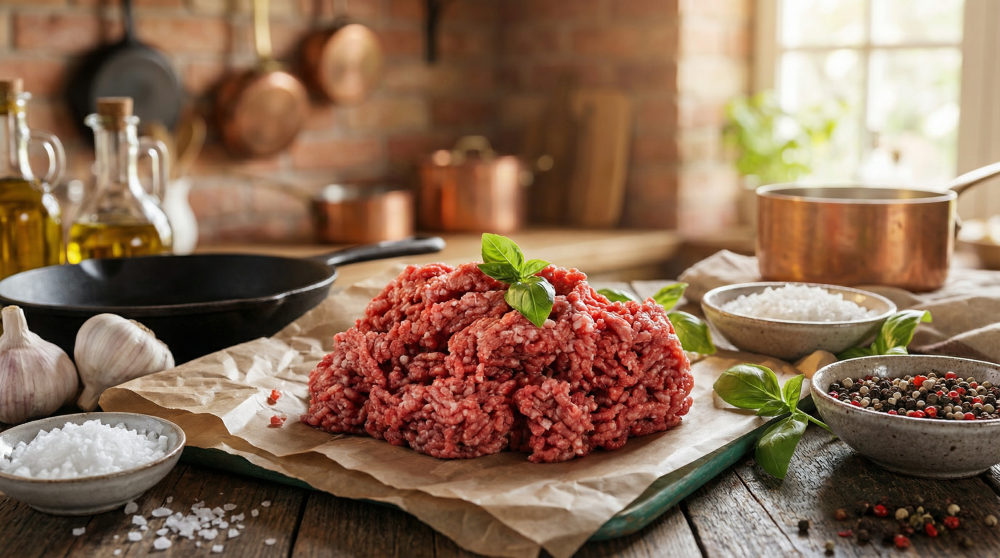
We have all been hearing about rising cattle prices. What we did not fully realize at first was how that would show up on our end. After purchasing cattle and sending them to the processor, we ran the numbers and discovered we were paying $10.20 per pound for ground beef and only charging our customers $11.70.
That is not a sustainable business.
That moment forced us into a deeper look at margins. What actually works, and what sounds like it should work but does not.
What we learned is this.
For us, a 50 percent gross margin works.
A 40 percent margin does not.
At first, that felt high. I remember wrestling with it, wondering if that meant we were doing something wrong. Wondering if we were way off compared to the rest of the grocery world.
In traditional grocery retail, margins really are thinner. Most supermarkets operate around a 25 percent gross margin, and after all expenses, their net margins are often just 1 to 3 percent. That model works when you have massive scale, razor-thin labor models, slotting fees, and constant pressure on suppliers.
It works for national chains. It does not work for a mission-driven, local food system that refuses to squeeze farmers.
What we are building lives in a different category. Closer to direct-to-consumer food, specialty retail, and values-driven brands. In those worlds, healthy gross margins often land closer to 40 to 60 percent. Not because anyone is greedy, but because the costs are real.
Lower volume.
Higher service.
More logistics.
More human touch.
Less ability to push risk onto someone else.
A Transparent Snapshot, Not the Final Answer
This is not a permanent declaration about how Kakadoodle must operate forever. It is simply what we are learning right now, in this season of the business.
Some of this will change with time. Some of it will improve with scale. Some of it we will look back on and say, “We did the best we could with what we knew then.”
But this is our reality today.
So when you hear us talk about pricing, or margins, or costs, it is not because we want to maximize profit. We're certainly not rolling in the dough.
It is because we are trying to build a system that does not rely on squeezing farmers, burning out founders, or cutting corners on quality.
We wanted to share this not to ask for sympathy, and not to make excuses.
Just to give you a transparent, behind-the-scenes look at what it really takes, in dollars and cents, to build a resilient local food system.
Because Kakadoodle is not just about delivering food.
It is about building something that can keep delivering food, week after week, year after year.