


article Why We Planted a Thousand Trees
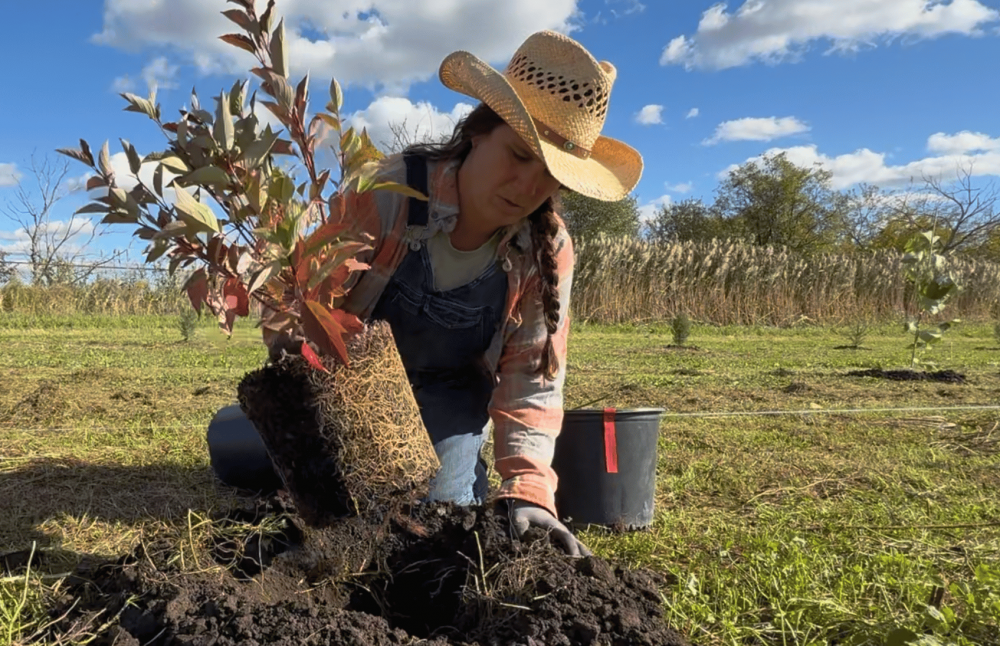
A few short weeks ago, everything at Kakadoodle was still green. Grass moving in the breeze, blue skies, warm fall days. Then — in true Chicago fashion — winter showed up almost overnight. Now the landscape is frozen and quiet… but tucked beneath the snow are more than 1,000 young trees we planted this fall.
These aren’t landscaping trees. And before I get into why we planted them, it’s worth zooming out to look at what happened to trees on American farms in the first place.
Hedgerows Used to Be Normal
A road trip through the Midwest typically means endless rows of corn and soybeans stretching to the horizon. One crop, repeating forever. I’ll admit — there’s a certain beauty to it, especially at sunset. But have you ever stopped and asked, is this normal? Or even, is this good?
Before industrial agriculture, hedgerows lined almost every farm field. They were natural fences, windbreaks, bird habitat, snow control, erosion protection — a whole ecosystem wrapped around the edges of the farm.
They weren’t “environmental practices.” They were just good farming.
But in the 1970s, something shifted.
Earl Butz and the “Fencerow to Fencerow” Era
U.S. Secretary of Agriculture Earl Butz famously told farmers to plant “fencerow to fencerow” and “get big or get out.”
The idea was simple: maximize yield. Every inch of land should be planted in corn or soy. Anything that didn’t produce profit — hedgerows, trees, wetlands — was treated as waste.
So across the Midwest, farmers ripped out the very features that made the land resilient.
Wind picked up. Wildlife vanished. Snow drifted unpredictably. Chemical drift traveled farther. The landscape became bare.
For my Chicago-area friends… remember that dust storm last summer? Woke up the next morning and every car had a fresh layer of soil on it. Strange, right?
That philosophy shaped the next fifty years.
And now we’re trying to unwind some of it.
Enter Kiss the Ground
The documentary Kiss the Ground helped popularize a different idea:
Healthy soil and diverse ecosystems can help restore climate balance.
The film argues that trees, perennials, and living roots aren’t just scenery — they’re the biological engine that stabilizes soil, builds carbon, increases water retention, and creates resilience.
I don’t think planting a thousand trees will reverse global warming.
But I do believe farms thrive when they look more like nature and less like a monoculture experiment.
Now, they're calling it "Agroforestry" — integrating trees with livestock and pasture. It's a return to re-incorporating multiple species onto the farm, returning to what nature does on its own.
What These Trees Will Actually Do
Here’s the honest, practical list of why we planted them this fall.
First, a quick note: this project only happened because three different grants came together at the same time — NRCS, CRP, and CAGP. I honestly wasn’t expecting any of them to be approved, but they were… so we got to planting.
And here’s the funny thing about grants: reintroducing trees has always been part of the long-term vision for our farm, but given where our company is right now — financially and operationally — I never would’ve prioritized planting thousands of trees on my own. There are definitely more “urgent” things we could be doing.
But the grants lined up, and fortunately, nothing went sideways. The whole project ended up feeling surprisingly smooth. Looking back, I’m really glad we did it.
Here’s why trees matter for the big picture:
-Windbreaks: Chicago wind is brutal. These rows will slow it down, protecting soil, animals, and infrastructure.
-Natural Habitat for Chickens: Once mature, the trees will create a woodland-edge environment our chickens instinctively prefer — shade, cover from aerial predators, insect life, and richer forage.
-Shade for Future Livestock: We hope to bring goats, sheep, and eventually cattle onto pasture. Trees will give them shade, comfort, and a healthier grazing environment. Animals perform better in silvopasture — calmer, cooler, healthier.
-Microclimate Boost: Grass between the tree rows grows better. Snow settles more evenly. Moisture stays where we need it.
-Wildlife Return: Owls, hawks, songbirds, pollinators — everything that disappears in bare landscapes starts coming back.
-Reduced Chemical Drift: Not eliminated, but reduced. A mature windbreak is far better protection than an open field.
-Carbon and Soil Health: Trees pump carbon underground and build soil. It’s slow but real.
Planting Trees in Fall… and Waiting Through Winter
Fall is the perfect time to plant. Moist soil, cool weather, and no heat stress give young trees the best possible start. And honestly, we timed it pretty well. We had to water the first batch of 300 trees because we barely got any rain — definitely a time suck. But the second batch of 1,000? They went in the ground, and it rained the very next day. A beautiful thing. And then it kept raining on and off right up until our first snow.
Now, in the dead of winter, it might look like nothing is happening — but beneath the surface, the roots are settling in and quietly preparing for spring.
It’s a long game.
The payoff comes years from now.
But when these trees hit twenty feet tall…
When the chickens are dust-bathing underneath them…
When goats are browsing along their edges…
When sheep and cattle are moving through shaded alleys of pasture…
This farm is going to feel completely different.
More alive.
More resilient.
More like a place our kids — and their kids — will be proud of.
Let's Bring Hedgerows Back
If the 1970s tore hedgerows out of the American landscape, maybe the 2020s are about bringing them back.
Not as nostalgia.
Not as decoration.
But because farms function better when they work with nature instead of against it.
And year by year, these trees will transform the entire farm.
Thanks for reading — and for being part of this journey.