
article What's all this Talk about PUFA in Eggs?
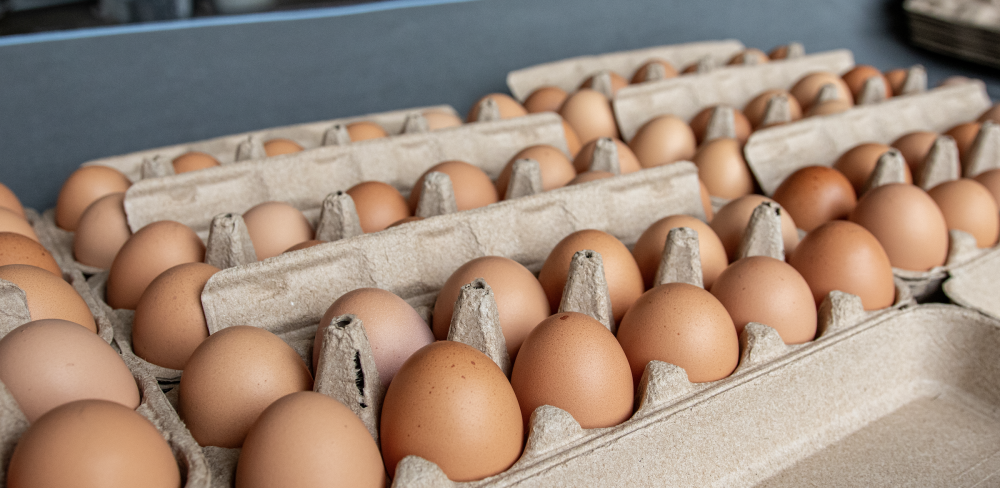
We’ve been tagged in a few posts lately about PUFAs, corn and soy, and egg feed. There are a lot of strong opinions out there, and honestly, there is no clear consensus.
We don’t want to get pulled into a nutrition fight, political arguments, or internet purity tests.
So here’s what we do know from actually raising chickens and running a farm.
A really important baseline that often gets missed
It’s worth saying this plainly, because online conversations often skip this part:
Nearly all eggs are from hens fed corn and soy.
That includes:
- conventional eggs
- cage-free eggs
- organic eggs
- pasture-raised eggs
- "farm fresh" eggs from your neighbor
Yes... even on pasture:
- Grass and bugs alone do not meet a laying hen’s nutritional needs.
- In most climates, forage is seasonal and inconsistent.
- To keep hens healthy and laying, farmers must supplement with feed.
Pasture access does not eliminate the need for grain. It changes the context of the diet, not the reality that supplemental feed is required.
So “pasture-raised” does not automatically mean “corn and soy-free,” whether the eggs come from a grocery store or a local farm.
For better or worse, corn and soy are the backbone of poultry feed in the U.S.
What we feed today
Right now, we feed our hens eat this non-GMO layer feed from Kalmbach:
- 50 lb bags
- Roughly $0.40 per pound
- Corn and soybean meal are part of the formula
This is a solid, reliable (and most importantly - chemical-free) feed that keeps hens healthy and laying consistently in our climate and system.
What corn and soy-free would change
We’ve looked closely at Kalmbach’s corn and soy-free option (their Organic Henhouse Reserve):
- 30 lb bags
- Roughly $1.13 per pound
- Nearly 3× the cost per pound
Feed is the single biggest cost on a poultry farm.
We buy feed in bulk, roughly 6 tons at a time.
Switching feeds would take our feed bill from about $3,000 to $9,000.
What that means for egg prices
Based on our numbers:
- Estimated cost to produce a dozen corn and soy-free eggs: $8.20
- To operate sustainably at a ~50% margin, those eggs would need to retail for about $16.40 per dozen
A quick reality check
Interestingly... the Vital Farm study that these posts are referencing were funded by Angel Acres Farm, a corn and soy-free producer.
Guess how much their eggs sell for? You guessed it: $16.50 per dozen.
That doesn’t make the data wrong, but it does help explain why this conversation is suddenly everywhere. It’s a very effective (might I even say brilliant!) marketing story tied to growing curiosity around PUFAs, seed oils, and nutrition.
Where we actually stand
Corn and soy-free feed is not new to us. It’s been on our radar for a while, and I recently wrote about it here:
👉 Are Corn and Soy-Free Eggs Healthier?
https://kakadoodle.com/post/Are+Corn+and+Soy-Free+Eggs+Healthier%3F
We are genuinely intrigued by the idea of experimenting with it.
What we don’t know is whether there is a real, sustainable market willing to support eggs at that price point, week after week, not just in comments.
Help us decide
If you would seriously be interested in corn and soy-free eggs at roughly $16.40 per dozen, comment and let us know.
Not to debate nutrition.
Not to argue online.
Just so we understand whether the demand is actually there to make an experiment like this viable.
As always, we’ll be transparent about what we do, what it costs, and why we make the choices we make.